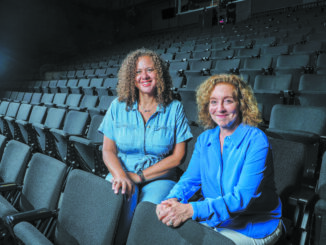
WEAVE and Youth Activists Tackle Teen Dating Violence Through Outreach and Awareness
by Dorsey Griffith
Sonia Sharma was in middle school when she heard about a friend who’d been followed out of a local coffee shop by a male student. The two had argued and the boy then attacked her. The incident shocked Sonia.
“You have the idea you are sheltered, and all that bad stuff happens out there, not here. That was a harsh reality check for me.”
Her friend’s experience sparked Sonia’s interest in finding ways for girls to defend themselves.
Sonia is a member of the Youth Advisory Council of the California Commission on the Status of Women and Girls (CCSWG). She is part of the group’s Safety and Prevention Subcommittee, which is currently recommending policy recommendations in the 2026 Girls Agenda, including:
- Make investments in providing self-defense training as part of physical education classes in grades K-12
- Create standardized statewide frameworks and resources for schools to integrate into their education on teen dating violence. Information should include recognizing the signs of teen dating violence, identifying what unhealthy relationships look like, and enhancing digital safety and literacy for combating dating violence that occurs in online environments
- Create more youth-centered teen dating violence resources as most existing resources are adult-oriented and no hotline exists for teen dating violence. A future hotline should also be pursued as a text line, a more user-friendly method that youth feel more comfortable utilizing
- Provide K-12 sexual violence and Title IX sensitivity training to school principals, who act as the final decision-maker in Title IX cases
“When we looked at existing policy, we found that the majority of it was responsive to victims of violence,” she says. “We do need that, but we also need to look at it from the preventive angle.”
When it comes to dating violence among high school students, one in 12 will experience physical or sexual violence while dating, according to Beth Hassett, chief executive officer of WEAVE, a nonprofit primary provider of crisis intervention services for survivors of domestic violence and sexual assault. Hassett adds that 21 percent of the 285 sexual assault exams that WEAVE advocates responded to in 2025 were for children 17 years old or younger.
“When we looked at existing policy, we found that the majority of it was responsive to victims of violence. We do need that, but we also need to look at it from the preventive angle, as well.”
Sonia Sharma
Councilmember, Youth Advisory Council
“Kids as young as fourth graders don’t know what a healthy relationship looks like,” Hassett says. “There aren’t a lot of healthy relationships being modeled on TV or in the movies.”
Social media is another trouble point, often used to stalk, groom and threaten children and teens. Its usage for abuse and exploitation are increasingly prevalent and poses significant risks.
“It starts with online bullying. They have little boyfriend interactions as early as age 9 or 10. It may be someone getting a girl to send them a naked picture, then using it to get back at them for breaking up or to destroy their reputation,” she says. “And then TikTok is telling girls they like to be strangled when boys are having sex with them.”
It’s not always someone they know either. Predators posing as teen boys engage girls and teens with fake profiles, luring them into in-person meetings and sexually assaulting them.
Hassett says to help prevent teen sexual violence, parents should look for any changes in their child’s behavior, particularly in their style of dress or their friend group.
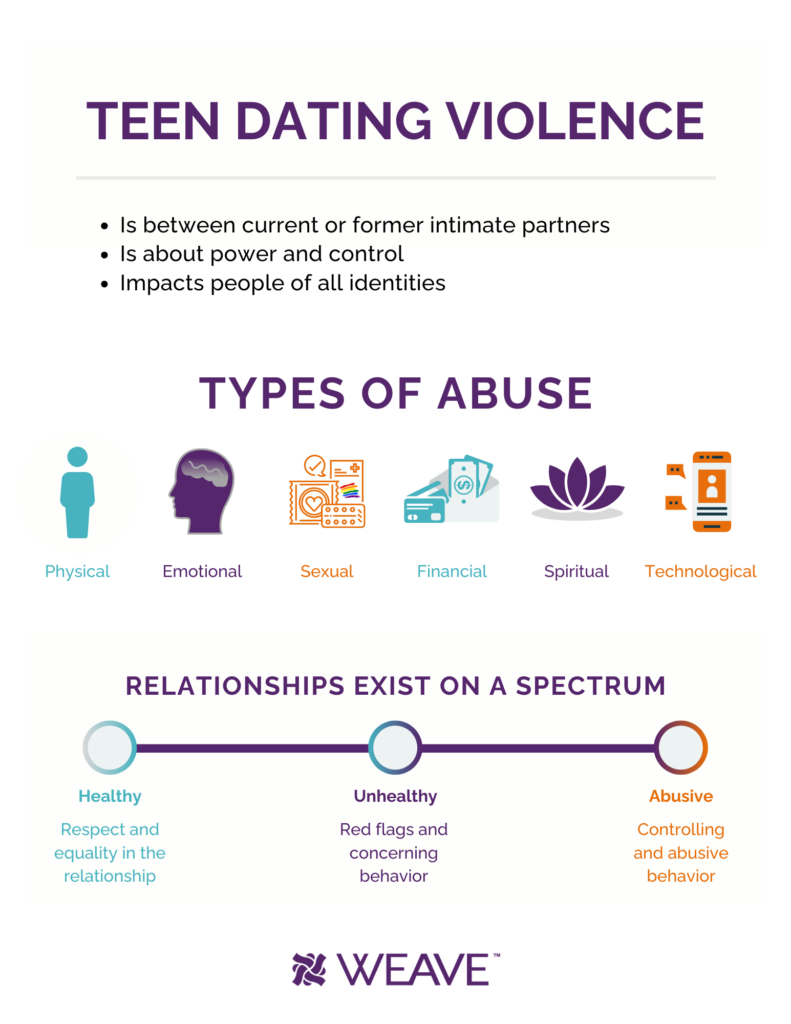
Teen dating abuse can be sexual, physical, emotional, financial, technological or spiritual.
Graphic Courtesy WEAVE
Other red flags for parents are large age gaps between teens and their boyfriends, or a teen who is sneaky with their online activities or blocks their parents’ access to their social media accounts.
Sonia, who graduates in June and concludes her 1-year term on the council in August, recognizes that many challenges remain and plans to continue her work to end abuse and violence against girls and teens. Sonia is helping CCSWG advocate for legislation to help educate and prevent teen sexual violence including supporting AB 1792 (Rodriguez) Pupil instruction, a bill that would require the Instructional Quality Commission to consider including and recommending for adoption by the state board specific content related to sexual health instruction to educate pupils about dating abuse and digital violence.
She heads to college in the fall to pursue a political science degree and, possibly, a career as a women’s lobbyist – inspired, in part, by her work on the commission.
“You learn so many skills and walk away knowing you helped other people and made a difference,” she says.
For more information on the California Commission on the Status of Women and Girls visit https://women.ca.gov/